
Friday, January 31, 2020

Tuesday, November 26, 2019
"Romantic Vision Concert" by David Leehey
The Symphony will perform “Romantic Vision” this Sunday December 1 at 4 PM at Concordia Chapel of Our Lord. This concert will highlight the organ, sometimes called “The King of Instruments”. All three composers featured in this concert were born in the 1820s and lived and composed during the height of the Romantic era.
The program will open with Organ Concerto No. 2 in G minor by Josef Rheinberger (1829-1901), a composer from the tiny country ot Liechtenstein, nestled between Austria and Switzerland. He was an organist from the age of seven and music for organ makes up the largest part of the composer's output.
This concerto follows a typical three-movement structure, with two fast sonata-form movements flanking a slower ternary (A-B-A) movement. As in Chopin’s piano concertos, there is no spectacular cadenza for the soloist and the solo part is nearly continuous. The concerto begins dramatically, with a catchy and rhythmically jagged motif. The second theme’s noble lyricism is reminiscent of Edward Elgar’s slightly later Enigma Variations.
The slow movement features a songlike theme that recurs in subtle variants, reminiscent of Schumann. The theme of the middle section is more vigorous, and the lovely transition back to the first theme shows off Rheinberger’s compositional skill.
The finale begins with a hammering theme but finishes with a charming closing theme slightly reminiscent of Schubert’s Ninth Symphony.
Melody Turner, a violinist in the Symphony, will demonstrate her skills as an organist in this performance. Melody and her family have lived in Oak Park since 1989. For 21 years, she was the organist/choirmaster at the Church of Our Savior (Episcopal) in Chicago. She is currently the organist at Saint Paul’s Episcopal Parish in Riverside. Melody has served on the board of the Chicago Chapter of the American Guild of Organists and actively participates in their concert series and other events.
The first half will then conclude with a performance of the opening movement of the Fifth Violin Concerto of virtuoso violinist Belgian composer Henri Vieuxtemps (1820-1881), played by our Concerto Competition winner, 14-year-old Sameer Agrawal.
After intermission comes the monumental Symphony No. 3 in D minor by Austrian composer Josef Anton Bruckner (1824-1896).
Bruckner was something of an enigma. Unlike many other composers, Bruckner showed extreme humility before other musicians. He was very self-critical of his work and often reworked his compositions, resulting in several versions of many of his compositions, resulting in a substantial workload for future musicologists. Bruckner was a good-natured man, but lacking social graces, appearing awkward and childishly naïve. His musical ability and outward persona thus did not match; the pianist and conductor Hans von Bulow referred to him as “half genius, half simpleton”.
Bruckner was born in a small Austrian village into a family of farmers and craftsmen. His father was his first music teacher, and young Anton learned to play the organ, often practicing for up to 12 hours a day. His father died when he was age 13, after which he was sent to a monastery in St. Florian in Linz, where he became a choirboy. He was in awe of the great organ there, which he played during services, and which later was to be called the “Bruckner organ”. Largely self-taught as a composer, the sound of the organ influenced many of his orchestral compositions, though interestingly he did not compose any significant organ works.
Bruckner was a lifelong bachelor who made numerous unsuccessful marriage proposals, mostly to teenage girls. Although this behavior resulted in some consternation, there may have been a benign intent. A devout Catholic, his interest in young girls seems to have been motivated by his fear of sin; he believed that (unlike older women) teenage girls would be virgins. His unsuccessful proposals to teenagers continued until he was past his 70th birthday.
Bruckner died in Vienna in 1896 at the age of 72. He is buried in the crypt of the monastery church at St. Florian in Linz, immediately below his favorite organ. He had always had a morbid fascination with death and dead bodies (he kept a photo of his mother’s corpse) and left explicit instructions regarding the embalming of his corpse using the newly-discovered formalin. It was even said that he kissed the skulls of Beethoven and Schubert when their corpses were exhumed and moved to a different cemetery.
The Symphony No. 3 in D minor was composed in 1873. Bruckner’s infatuation with the music of Wagner is manifest throughout the Third Symphony. He had grown passionate about Wagner’s music while still in Linz, and in 1865 he traveled to Munich (at the composer’s invitation) to attend the premiere of Tristan und Isolde, the first of several Wagner premieres he would attend.
In September 1873, another of Bruckner’s pilgrimages took him to Bayreuth, where Wagner was overseeing construction of his dream theater. He carried along the manuscripts of his Second and Third Symphonies — the latter not yet complete — and hoped to persuade Wagner to accept the dedication of one or the other of them.
Bruckner proved persistent and was eventually granted an audience with his idol. He reported in a letter to a friend that he had said “Master, I have no right to rob you of even five minutes, but I am convinced that the highly acute glance of the Master would only have to see the themes, and the Master would know what to think of it all.” Then, he reports that the Master said to him, “Very well, come along!”.
Wagner took the Third (D minor) and with the words, “Look! Look! I say! I say!” he went through the entire first part (commenting particularly on the trumpet) and then he said: “Leave this work here; after lunch I will have another look at it.” Wagner was surely delighted to spot in the first two movements of Bruckner’s Third Symphony clear references to his own operas Die Walküre and Tristan und Isolde, as well as more subtle allusions to Tannhäuser and Die Meistersinger.
By the time Bruckner returned to his lodgings he had extricated Wagner’s acceptance of a dedication though he and Wagner drank so much beer together that he had to write back to make sure which of the two symphonies was being dedicated!
The Third Symphony begins mysteriously, with the trumpet outlining the D minor key.
This is eventually followed by a fortissimo passage for full orchestra.
The second theme is introduced with a quiet, descending motif played by the strings:
The third theme varies between loud and soft and has two typical Bruckner trademarks, falling octaves and the “Bruckner rhythm”
During the development, the main theme is developed through inversion and is the subject of a massive climax. The movement ends in an unusual fashion: while there is no ambiguity as to the tonic (D), the final "chord" only contains an open fifth of D and A. Since there is no third, the ending is neither major nor minor:
The Adagio opens quietly and has with the strings playing in four parts:
The Scherzo also begins quietly, quickly building up to a belligerent passage that consists mainly of the notes D and A
The Finale's main theme is a recall of the trumpet theme of the first movement, sharing the same rhythm:
Long after his death, the Nazis strongly approved of Bruckner's music because they saw it as expressing the zeitgeist of the German volk. Near the end of World War II, Adolf Hitler planned to convert the monastery of St. Florian into a repository of Bruckner's manuscripts. Hitler evicted the monks from the building and personally paid for the restoration of the organ and the institution of a Bruckner study center there. The Adagio from Bruckner's Seventh Symphony was broadcast by German radio (Deutscher Reichsrundfunk) when it announced the news of Hitler's death on May 1, 1945. None of this association with the Nazi era has ever reflected on Bruckner, who, unlike his idol Wagner, was never known as an anti-Semite.
Bruckner’s symphonies are often called “cathedrals of sound”. Come hear for yourself.
The program will open with Organ Concerto No. 2 in G minor by Josef Rheinberger (1829-1901), a composer from the tiny country ot Liechtenstein, nestled between Austria and Switzerland. He was an organist from the age of seven and music for organ makes up the largest part of the composer's output.
This concerto follows a typical three-movement structure, with two fast sonata-form movements flanking a slower ternary (A-B-A) movement. As in Chopin’s piano concertos, there is no spectacular cadenza for the soloist and the solo part is nearly continuous. The concerto begins dramatically, with a catchy and rhythmically jagged motif. The second theme’s noble lyricism is reminiscent of Edward Elgar’s slightly later Enigma Variations.
The slow movement features a songlike theme that recurs in subtle variants, reminiscent of Schumann. The theme of the middle section is more vigorous, and the lovely transition back to the first theme shows off Rheinberger’s compositional skill.
The finale begins with a hammering theme but finishes with a charming closing theme slightly reminiscent of Schubert’s Ninth Symphony.
Melody Turner, a violinist in the Symphony, will demonstrate her skills as an organist in this performance. Melody and her family have lived in Oak Park since 1989. For 21 years, she was the organist/choirmaster at the Church of Our Savior (Episcopal) in Chicago. She is currently the organist at Saint Paul’s Episcopal Parish in Riverside. Melody has served on the board of the Chicago Chapter of the American Guild of Organists and actively participates in their concert series and other events.
The first half will then conclude with a performance of the opening movement of the Fifth Violin Concerto of virtuoso violinist Belgian composer Henri Vieuxtemps (1820-1881), played by our Concerto Competition winner, 14-year-old Sameer Agrawal.
After intermission comes the monumental Symphony No. 3 in D minor by Austrian composer Josef Anton Bruckner (1824-1896).
Bruckner was something of an enigma. Unlike many other composers, Bruckner showed extreme humility before other musicians. He was very self-critical of his work and often reworked his compositions, resulting in several versions of many of his compositions, resulting in a substantial workload for future musicologists. Bruckner was a good-natured man, but lacking social graces, appearing awkward and childishly naïve. His musical ability and outward persona thus did not match; the pianist and conductor Hans von Bulow referred to him as “half genius, half simpleton”.
Bruckner was born in a small Austrian village into a family of farmers and craftsmen. His father was his first music teacher, and young Anton learned to play the organ, often practicing for up to 12 hours a day. His father died when he was age 13, after which he was sent to a monastery in St. Florian in Linz, where he became a choirboy. He was in awe of the great organ there, which he played during services, and which later was to be called the “Bruckner organ”. Largely self-taught as a composer, the sound of the organ influenced many of his orchestral compositions, though interestingly he did not compose any significant organ works.
Bruckner was a lifelong bachelor who made numerous unsuccessful marriage proposals, mostly to teenage girls. Although this behavior resulted in some consternation, there may have been a benign intent. A devout Catholic, his interest in young girls seems to have been motivated by his fear of sin; he believed that (unlike older women) teenage girls would be virgins. His unsuccessful proposals to teenagers continued until he was past his 70th birthday.
Bruckner died in Vienna in 1896 at the age of 72. He is buried in the crypt of the monastery church at St. Florian in Linz, immediately below his favorite organ. He had always had a morbid fascination with death and dead bodies (he kept a photo of his mother’s corpse) and left explicit instructions regarding the embalming of his corpse using the newly-discovered formalin. It was even said that he kissed the skulls of Beethoven and Schubert when their corpses were exhumed and moved to a different cemetery.
The Symphony No. 3 in D minor was composed in 1873. Bruckner’s infatuation with the music of Wagner is manifest throughout the Third Symphony. He had grown passionate about Wagner’s music while still in Linz, and in 1865 he traveled to Munich (at the composer’s invitation) to attend the premiere of Tristan und Isolde, the first of several Wagner premieres he would attend.
In September 1873, another of Bruckner’s pilgrimages took him to Bayreuth, where Wagner was overseeing construction of his dream theater. He carried along the manuscripts of his Second and Third Symphonies — the latter not yet complete — and hoped to persuade Wagner to accept the dedication of one or the other of them.
Bruckner proved persistent and was eventually granted an audience with his idol. He reported in a letter to a friend that he had said “Master, I have no right to rob you of even five minutes, but I am convinced that the highly acute glance of the Master would only have to see the themes, and the Master would know what to think of it all.” Then, he reports that the Master said to him, “Very well, come along!”.
Wagner took the Third (D minor) and with the words, “Look! Look! I say! I say!” he went through the entire first part (commenting particularly on the trumpet) and then he said: “Leave this work here; after lunch I will have another look at it.” Wagner was surely delighted to spot in the first two movements of Bruckner’s Third Symphony clear references to his own operas Die Walküre and Tristan und Isolde, as well as more subtle allusions to Tannhäuser and Die Meistersinger.
By the time Bruckner returned to his lodgings he had extricated Wagner’s acceptance of a dedication though he and Wagner drank so much beer together that he had to write back to make sure which of the two symphonies was being dedicated!
The Third Symphony begins mysteriously, with the trumpet outlining the D minor key.
This is eventually followed by a fortissimo passage for full orchestra.
The second theme is introduced with a quiet, descending motif played by the strings:
The third theme varies between loud and soft and has two typical Bruckner trademarks, falling octaves and the “Bruckner rhythm”
During the development, the main theme is developed through inversion and is the subject of a massive climax. The movement ends in an unusual fashion: while there is no ambiguity as to the tonic (D), the final "chord" only contains an open fifth of D and A. Since there is no third, the ending is neither major nor minor:
The Adagio opens quietly and has with the strings playing in four parts:
The Scherzo also begins quietly, quickly building up to a belligerent passage that consists mainly of the notes D and A
The Finale's main theme is a recall of the trumpet theme of the first movement, sharing the same rhythm:
Long after his death, the Nazis strongly approved of Bruckner's music because they saw it as expressing the zeitgeist of the German volk. Near the end of World War II, Adolf Hitler planned to convert the monastery of St. Florian into a repository of Bruckner's manuscripts. Hitler evicted the monks from the building and personally paid for the restoration of the organ and the institution of a Bruckner study center there. The Adagio from Bruckner's Seventh Symphony was broadcast by German radio (Deutscher Reichsrundfunk) when it announced the news of Hitler's death on May 1, 1945. None of this association with the Nazi era has ever reflected on Bruckner, who, unlike his idol Wagner, was never known as an anti-Semite.
Bruckner’s symphonies are often called “cathedrals of sound”. Come hear for yourself.
Saturday, April 27, 2019
All About Our May 12 Concert
by David Leehey
Our Mother's Day program will open with our concerto competition winner Leah Iosevich playing a work for violin and orchestra by English composer Ralph Vaughan Williams called The Lark Ascending. This will be followed on the first half of the program by the Concerto Grosso No.1 by Ernest Bloch, a Swiss-born Jewish American emigree.
What is a concerto? According to the "new font of all knowledge", Wikipedia, a concerto is a musical composition in which, usually, one solo instrument (for instance, a piano, violin, cello or flute) is accompanied by an orchestra or concert band. The word concerto comes from Italian; its origin is uncertain, but it seems to originate from the conjunction of two Latin words: conserere (meaning to tie, to join, to weave) and certamen (competition, fight). So how do you join and fight at the same time? You don't, but you can alternate between episodes of opposition and cooperation, which is what typically happens in a concerto.
The instrumental concerto arose in the late Baroque period (ca. 1700-1750). During that time, a form of concerto called the concerto grosso, which contrasted a small group of instruments called a concertino with the rest of the orchestra, called the ripieno, was standard fare. Handel wrote several collections of concerti grossi, and several of the Brandenburg Concertos by Bach loosely follow the concerto grosso form. The popularity of the concerto grosso declined after the Baroque period, only to be revived in the 20th century. In the interim, the solo concerto, one instrument playing with (and against) an orchestra, reigned, and continues to do so today.
Solo concerti were also written during the Baroque era, with the solo instrument usually being a string instrument (such as the violin, viola, and cello) or a wind instrument (usually a flute, recorder, oboe, bassoon, horn, or trumpet). Bach wrote a famous concerto for two violins and orchestra. Keyboard concertos were comparatively rare until the evolution of the modern piano, whose increased volume and the richer sound could compete with a full orchestra.
During the Classical period (ca. 1750-1820), the solo concerto really came into its own. Mozart wrote five violin and 27 piano concertos, as well as concerti for other instruments. Beethoven wrote only one violin concerto and five piano concertos, but all remain in the standard repertoire. Haydn wrote two cello concertos which also remain popular today.
In the 19th century the concerto became a vehicle for virtuosic display. This was the Romantic era, and the solo artist was seen as a hero. Many famous concertos were written by composers such as Schumann, Chopin, Tchaikovsky, Mendelssohn, Brahms, and Dvořák, among many others. Many of these pieces are among the most popular compositions in the history of music. Such virtuosic pieces continued to be written in the 20th century by composers such as Elgar, Rachmaninoff, Sibelius, Bartók, and Prokofiev.
But let’s return back to our Mother’s Day Concert. Neither of the two concerto pieces on the first half of the program are typical concertos (by the way, the plural is technically concerti, but concertos is more commonly used in English). There are so many great examples of a typical concerto to be heard on YouTube that it is hard to choose just one, but I will choose Beethoven’s Concerto No. 5 for Piano and Orchestra (the “Emperor” Concerto) as my example of a typical concerto.
- First of all, it is generally recognized as one of the masterpieces of the concerto literature.
- Second, you only need to listen for a few moments to hear the competition between the soloist and orchestra. After a loud opening orchestral chord, the piano soloist enters with a flourish of scales, arpeggios (broken chords), and trills, which leads to another loud orchestral chord (take that!), followed by yet another even more virtuosic piano passage, leading to (you guessed it) a third loud orchestral chord. The piano soloist, not to be outdone, plays another flourish, leading to the beginning of the main theme.
Vaughan Williams’ The Lark Ascending could hardly be more different from the “Emperor” Concerto. The composer wrote this beautiful idyll in 1914 before the onset of the Great War, revising it in 1920. The inspiration for the piece was the eponymous George Meredith poem:
He rises and begins to round,
He drops the silver chain of sound,
Of many links without a break,
In chirrup, whistle, slur and shake.
For singing 'til his heaven fills,
'Tis love of earth that he instils,
And ever winging up and up,
Our valley is his golden cup,
And he the wine which overflows
To lift us with him as he goes
'Til lost on his aerial rings
In light, and then the fancy sings.
A warm, hazy, rising orchestral opening lifts the solo violin into a rhapsodic soaring fluttering tune. The soloist and orchestra interweave their sounds throughout this gently lyrical piece, though there is a daring and innovative unaccompanied cadenza for the violin (lark) to close the work.
Ernest Bloch’s Concerto Grosso No.1 was written in 1925 as a challenge to his students at the Cleveland Institute of Music, for which he was the founding director. Encountering skepticism regarding the usefulness of “old” techniques (such as tonality and classical form!) when writing new music, the composer chose to prove his point by composing a new work using these old techniques in a modern way. At the first rehearsal, the school orchestra played through this new piece with enthusiasm, leading Bloch to shout triumphantly, “What do you think now? This is tonal! It just has old-fashioned notes!”
Bloch’s point was not that new works should be created exactly in the style of older ones, but that new and exciting music could evolve by combining aspects of various musical techniques. Bloch infused the Baroque concerto grosso structure with the rhythmic and melodic sensibility of the romantics and the polytonal harmonies of the early 20th century, using “old-fashioned notes” to create something entirely new.
The Concerto Grosso No. 1 begins with a prelude of grand, dramatic statements; a dirge follows, with ethereal textures evoking the Impressionistic world of Debussy or Ravel. The third movement brings a new perspective to the baroque fondness for including dance music in concert suites. And naturally, the final movement is that most characteristic Baroque form, the fugue. Bloch masterfully juggles musical textures between three groups: solo strings, section strings, and piano (an update to Bach’s harpsichord).
A final word about this piece: it is most definitely not a piano concerto. The piano is one of the instruments of the ensemble and should be positioned in the midst of the ensemble.
-David Leehey
Sunday, November 4, 2018
Veterans Day Concert
November 11, 2018
November 11, 2018
November 11, 2018 marks the 100th anniversary centennial of the end of World War I. In remembrance of this historical event, and since November 11, 2018 happened to fall on a Sunday, the Symphony decided to program a Veterans Day Concert this year. The artistic committee spent considerable time and effort on the program, deciding in the end on three pieces, one each by an American composer, a French composer, and a British composer.
The concert will start with a short piece by Morton Gould entitled American Salute, its theme based on the Civil War era song “When Johnny Comes Marching Home”. Interestingly, the premiere of this piece was on NBC radio on November 11, 1942, at the height of World War II.
The following two pieces on the program pay respects to the veterans of the first world war.
The next piece features our piano soloist Winston Choi, head of piano at the College of Performing Arts of Roosevelt University, who gave us a superb rendition of Beethoven’s Emperor Concerto two years ago.
The story of the Piano Concerto for the Left Hand by French composer Maurice Ravel is a fascinating one. It was written for Austrian pianist Paul Wittgenstein, a scion of one of Vienna's most remarkable families —Brahms was only one of the famous guests at the Wittgensteins’ celebrated gatherings.
When World War I broke out, Paul enlisted in the Austrian army. A few months later, he was shot and severely wounded, and his right arm was amputated. Being a member of a distinguished family of overachievers and survivors, and raised by a father of forceful determination, Wittgenstein did not give up his career as a pianist. (That same oppressive upbringing, however, may have led the two oldest sons to commit suicide.) Instead, he took family money and commissioned more than a dozen works for piano left-hand from some of the world's leading composers.
This concerto by Maurice Ravel was not the first, but it is generally regarded as the best. Written in 1929-1930, it contains many jazz effects that Ravel had picked up on his 1928 trip to the United States, during which he met bandleader Paul Whiteman and spent several nights visiting jazz clubs in Harlem with George Gershwin. (He also conducted the Chicago Symphony and continually complained about American food!).
It is clear from this work that Ravel had learned all about blue notes! A personal note..I first heard this piece when I was 14 years old. My parents had just bought a stereo system, and my mother brought home a record of this concerto from the library. I think she chose it because the pianist was John Browning, and she thought he was very handsome! I listened to the record so many times that I wore out the grooves. The piece remains a personal favorite.
The biggest work on the program is the Pastoral Symphony by British composer Ralph Vaughan Williams. It was during the composer’s service in World War I that he heard a bugler practicing, giving him the first idea for his Pastoral Symphony. He began work on the symphony just after the war ended, and it was completed in 1921 and first performed at a Royal Philharmonic Society concert at Queen’s Hall, London, on January 26, 1922.
The composer referred to this symphony in his first program notes as “almost entirely quiet and contemplative,” yet it is not without moments of underlying passion. The symphony is in four movements, with the second movement containing two cadenzas, the first for a natural trumpet (sounding a lot like a bugle) and the second for a natural horn. The final movement is unusual, beginning with a wordless soprano lament over a timpani roll. After the orchestra swells to an impassioned climax, the symphony will end with the same elegiac soprano melody disappearing into silence. In overall mood the Pastoral Symphony is quite different from most symphonies, but at the same time it is a quite moving testament to those who made the ultimate sacrifice.
Sunday, September 23, 2018
Riccardo Muti
Visits us for the 6th year!

The musicians of the orchestra are quite excited about the visit of Riccardo Muti, the eminent conductor of the Chicago Symphony Orchestra, known throughout the world for his musicianship and leadership.
Maestro Muti will take the orchestra through the "1821 Overture" by Tchaikovsky on Sunday, September 23 at 5 p.m.
There is free parking in the parking garage adjacent to the site of the rehearsal: Concordia University, corner of Bonnie Brae and Thomas in River Forest.
Bring a donation of food for the Oak Park Food Pantry.
Bring a donation of food for the Oak Park Food Pantry.
Sunday, April 15, 2018
Message from David Leehey, President of the Board
This is the concert you have been waiting for.
I call it "Choral Fantasies".
Beethoven did call his piece, "Choral Fantasy", but Carmina Burana is also a choral fantasy -- a choral piece with a lot of fantasy in it.
There are a lot more similarities between these pieces than one might think:
They are both joyous and fun.
Both have uncomplicated harmonies and melodies.
There is lots of C major in both!
Hope to see you at the concert
on Monday, April 23, 7:30 p.m.
Symphony Hall, 220 S. Michigan Avenue
Chicago, IL
Call 312-294-3000 for tickets.

Tuesday, February 13, 2018
Sad News About Our Webmaster
We are shocked and saddened by the sudden death of Janet Barnstable, our beloved webmaster.
Both Janet and her partner, Richard, perished in a house fire.
At this time, we are unable to post on the main site. We are seeking advice and support as we work toward the ability to post on our website.
For more information, contact Beth Hoover at: thesymphonyoprf@gmail.com
Sunday, September 24, 2017
Our New Season!
2017-2018
We are all looking forward to our fifth open rehearsal with the great conductor of the Chicago Symphony Orchestra, Maestro Riccardo Muti!
This will happen on October 1 at 7 p.m. at Concordia University in River Forest. (Free admission with the purchase of a ticket to our October 8th concert or a subscription to four concerts.)
Muti always brings his whole package of jokes and a wealth of musical knowledge! We learn so much from him! It's an honor to work with a world class musician!

Maestro Muti is a busy man. It's really wonderful that he donates his time to visit and instruct us! He sets a wonderful example about helping others in many ways!
Thursday, February 25, 2016
Two Titans of the Romantic Era
By David Leehey, Board President of The Symphony of Oak Park & River Forest
Our March 6 concert features music by the two titans of romantic-era German music, Johannes Brahms and Richard Wagner. Though today hearing the music of these two masters on the same program does not raise eyebrows, that was not always the case.
The "War of the Romantics" is a term used by some music historians to describe the aesthetic schism between two opposing musical philosophies in the 19th century. The conservatives favored Brahms, who was seen as the heir to the great tradition of German music as it had passed from the Baroque masters such as Bach, through the Viennese classicists (Haydn and Mozart), and on to the early 19th century romantics (Beethoven, Schumann, and Mendelssohn). They were believers in absolute music, meaning that the music, in its form, structure, melody, and harmony, could and should stand on its own merits. Their opponents were the progressives of the so-called New German School, led by Franz Liszt and Richard Wagner. The conservatives believed in writing sonatas, chamber music, concertos, and symphonies. The progressives were believers in program music, thinking that the music should tell a story (and often be accompanied by a narrative). This idea led to Liszt’s creation of the symphonic poem (or “tone poem”) and reached its apotheosis in the music dramas of Wagner.
As is true of many things in life, these two opposing camps were not really as dissimilar as many considered them to be at the time. Robert Schumann had been a progressive composer and critic as well as editor of the influential music periodical Neue Zeitschrift für Musik. He had artistically fruitful friendships with both the radical romantics — Liszt in particular — as well as with musical conservatives such as Mendelssohn. However as Liszt’s piano performance antics and the fervid audiences he left in his wake (sometimes called Lisztomania) swept through Europe in the 1840s, both he and his pianist wife Clara turned to the new savior of German music, Johannes Brahms.
Brahms and his fellow conservatives were to write a Manifesto against the perceived bias of the Neue Zeitschrift für Musik, which after Schumann’s death was controlled by the progressives. The manifesto lodged a protest againts the leaders and pupils of the New German School, declaring its theories, principles and practice to be “contrary to the innermost spirit of music, strongly to be deplored and condemned”. This became a catalyst for spreading the conflict to the German press at large. Liszt, to his credit, did not debate the manifesto; instead, he let his music speak for him. Brahms, after this one foray into musical politics, was to do the same in the future.
Although it is true that Brahms did not care much for the music of the progressives, the exception was Wagner. Whiles his fellow conservatives loved to despise Wagner's music, he respected it privately and once told his friends, "I am the best of Wagnerians."
Another piece of the “War of the Romantics” deserves mention. The composer and pianist Hans von Bülow initially supported the Liszt-Wagner side. That was until his wife, Liszt's daughter Cosima, left him for Wagner; he then switched his allegiance to Brahms. It was Bülow who called Brahms the third of the Three Bs, after Bach and Beethoven. It does not take a lot of imagination to see why Bülow would change camps.
In its time, the 'war' was often seen to reflect a clear demarcation between what was seen to be 'classical music' and 'modern music', categories which still persist (although differently defined) to the present day. Today when we listen to the music of Brahms and Wagner, we hear the similarities more than the differences.Sunday, October 11, 2015
Italian Music!!! Italian Food!!
Following our October 18, 2015 concert, at which we feature music by Vivaldi and Verdi, orchestra members, board members, audience members and families will gather at Trattoria 225 for dinner!Bill Quick, the owner of Trattoria 225, has planned a lovely meal at the cost of $25 a person. The restaurant is located at 225 Harrison in Oak Park in the Harrison Street Arts District.
Click here to see the menu

Sunday, September 20, 2015
A Very Special Event!
Riccardo Muti visits us!
For the third time in three years, Riccardo Muti, the world-renowned conductor of the Chicago Symphony Orchestra will come to work with the orchestra.
Maestro Muti has a mission: to reach out to the community at large. To that end he has taken the CSO to the inner city and to neighborhoods that never hear classical music. He wants to give to others!
We are very fortunate because the orchestra will be able to learn from and enjoy one of the greats of the musical world.
This event will take place on Wednesday, September 23 at 7:30 at Dominican University's Performing Arts Center. It is free to the public, no tickets required.
Come and watch!

Wednesday, July 1, 2015
Wedding Bells Will Ring
Two members of the orchestra have announced their up-coming wedding in September, 2015. They are Yi-Chen Huang, violin and Petr Husak, cello.
 The two met as fellow orchestra players and their romance bloomed.
Both are wonderful musical leaders and fun people! We wish them every
happiness!
The two met as fellow orchestra players and their romance bloomed.
Both are wonderful musical leaders and fun people! We wish them every
happiness!

Thursday Night Out, June 4, 2015
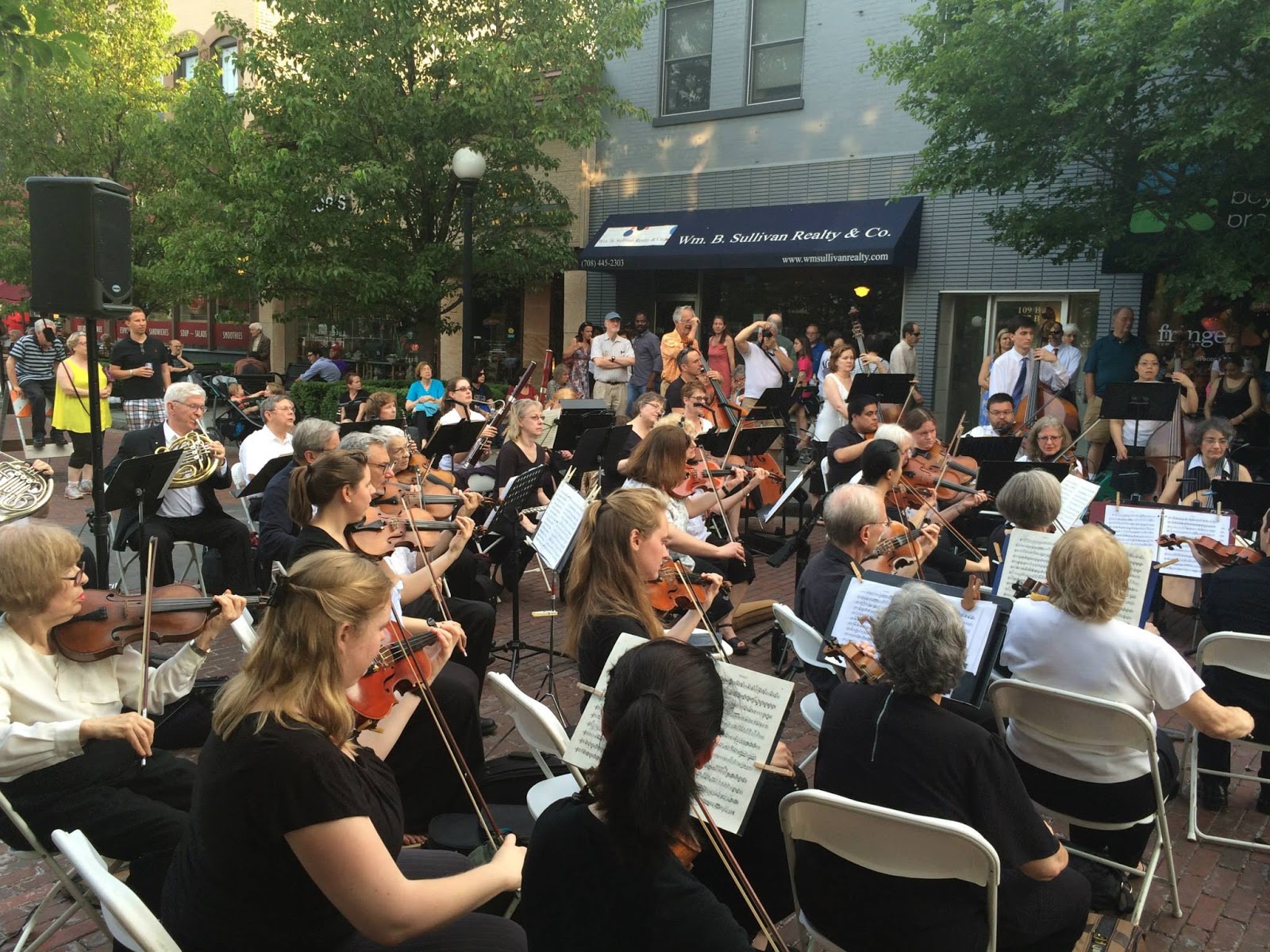
Barely taking a breath at the end of the season, orchestra members began preparing for yet another concert on June 4: Thursday Night Out in downtown Oak Park.
Under the direction of Maurice Boyer, our assistant conductor, the orchestra played the popular Symphony No. 40 by Mozart. A sizable crowd gathered in the street to hear us. For many, it was their first time to hear our orchestra. The orchestra was gratified by the rapt attention of the audience and their generous applause. We gained a number of new fans and a number of new subscribers!
Thanks to all who participated!

Under the direction of Maurice Boyer, our assistant conductor, the orchestra played the popular Symphony No. 40 by Mozart. A sizable crowd gathered in the street to hear us. For many, it was their first time to hear our orchestra. The orchestra was gratified by the rapt attention of the audience and their generous applause. We gained a number of new fans and a number of new subscribers!
Thanks to all who participated!
Dvorak, Then Dinner!
Following our final concert of the 2014/2015 season on May 3, audience, board members and players gathered at Klas Restaurant in Cicero. Having played an all-Dvorak concert, it was fitting and celebratory to meet at Klas' and dine on Czech-style food! A good time was had by all!


Thursday, February 12, 2015
Come to the party!
VALENTINE'S DAY DINNER DANCE
HOST: The Symphony of Oak Park & River Forest
WHEN: Saturday, February 14, 7 PM - 11:30 PM
WHERE: Skrine Chops - upstairs
7230 Madison Street, Forest Park, IL 60130
WHAT: Dinner, cash bar and dancing to all your romantic favorites! DJ Rick plays your special requests. Local artists will present a Valentine's Boutique. Shop for your special someone, enter a drawing to win fabulous prizes, or visit our silent auction.
TICKETS: $40 per person or two for $75
if purchased before February 12th.
Tickets at the door are $50 per person.
For more information or to reserve your tickets contact Carole Benson at 708/261-7181.
Tickets are going fast!

VALENTINE'S DAY DINNER DANCE
HOST: The Symphony of Oak Park & River Forest
WHEN: Saturday, February 14, 7 PM - 11:30 PM
WHERE: Skrine Chops - upstairs
7230 Madison Street, Forest Park, IL 60130
WHAT: Dinner, cash bar and dancing to all your romantic favorites! DJ Rick plays your special requests. Local artists will present a Valentine's Boutique. Shop for your special someone, enter a drawing to win fabulous prizes, or visit our silent auction.
TICKETS: $40 per person or two for $75
if purchased before February 12th.
Tickets at the door are $50 per person.
For more information or to reserve your tickets contact Carole Benson at 708/261-7181.
Tickets are going fast!
Thursday, January 29, 2015
Here's a great video from our March, 2014 concert!
Berlioz Romeo Alone and Festivities at the Capulets - Symphony of Oak Park & River Forest
Filmed and uploaded by Thomas Steffens.
Wednesday, January 21, 2015

Monday, September 29, 2014
"A TRIUMPH"
Jay Friedman (conductor), orchestra members and audience all agreed! Yesterday's concert was a huge success in every way: we had a very large and appreciative audience, Jay's conducting was spectacular and the orchestra performed at its highest level to date.
In "Pictures at an Exhibition, Stokowski's version, the orchestra pulled out all of the stops to create excitement and drama at every turn.
John Bruce Yeh and Teresa Reilly thrilled the audience with their beautiful playing of Mendelssohn's Konzertstück for two clarinets.
Our playing of Strauss's "Death and Transfiguration" was in top shape, due to the excellent tutoring session from Maestro Muti a few days earlier and executed in final form by Jay Friedman.
Many new audience members reported that they would be back!

Friday, September 26, 2014
Maestro Muti's Visit

Maestro Riccardo Muti came to our rehearsal on Wednesday, September 24! He helped us rehearse "Tod und Verklärung" by Richard Strauss, a piece we will perform at our concert on Sunday, September 28.
The mood of the orchestra was "excited", "thrilled", and "happy". We all tried to play our best! Maestro Muti set us at our ease immediately by his little jokes and huge charm! He was quite tough with us, though, asking us to repeat, repeat, repeat certain phrases until they were just right! It was like watching a potter shape a lump of clay into a beautiful object. In fact, he, himself, stated that conducting an orchestra was like sculpting a flower. As he spoke and showed with his hands the beautiful flower, we all knew what he meant.
What a fantastic evening! It's one we will never forget! Many thanks to our conductor, Jay Friedman, a colleague of Muti's, for arranging this great event!
Wednesday, September 24, 2014
Maestro Muti Returns!
Riccardo Muti, the esteemed conductor of the Chicago Symphony Orchestra, will come to our rehearsal on Wednesday, September 24. He will take us through "Death and Transfiguration" by Richard Strauss, which is to be played at our concert on September 28.
Last year, he worked with us at a rehearsal of "Les Préludes". It was magical to watch his hands and face as he communicated all of the musical directions without speaking! After the run-through, he asked us to play small sections of the music. He made suggestions on how to play it better. Meanwhile, he had us all smiling and laughing with his charming ways! So, not only did the orchestra learn a lot from the maestro, we enjoyed every minute.
I'll report tomorrow on how things went!
Subscribe to:
Posts (Atom)